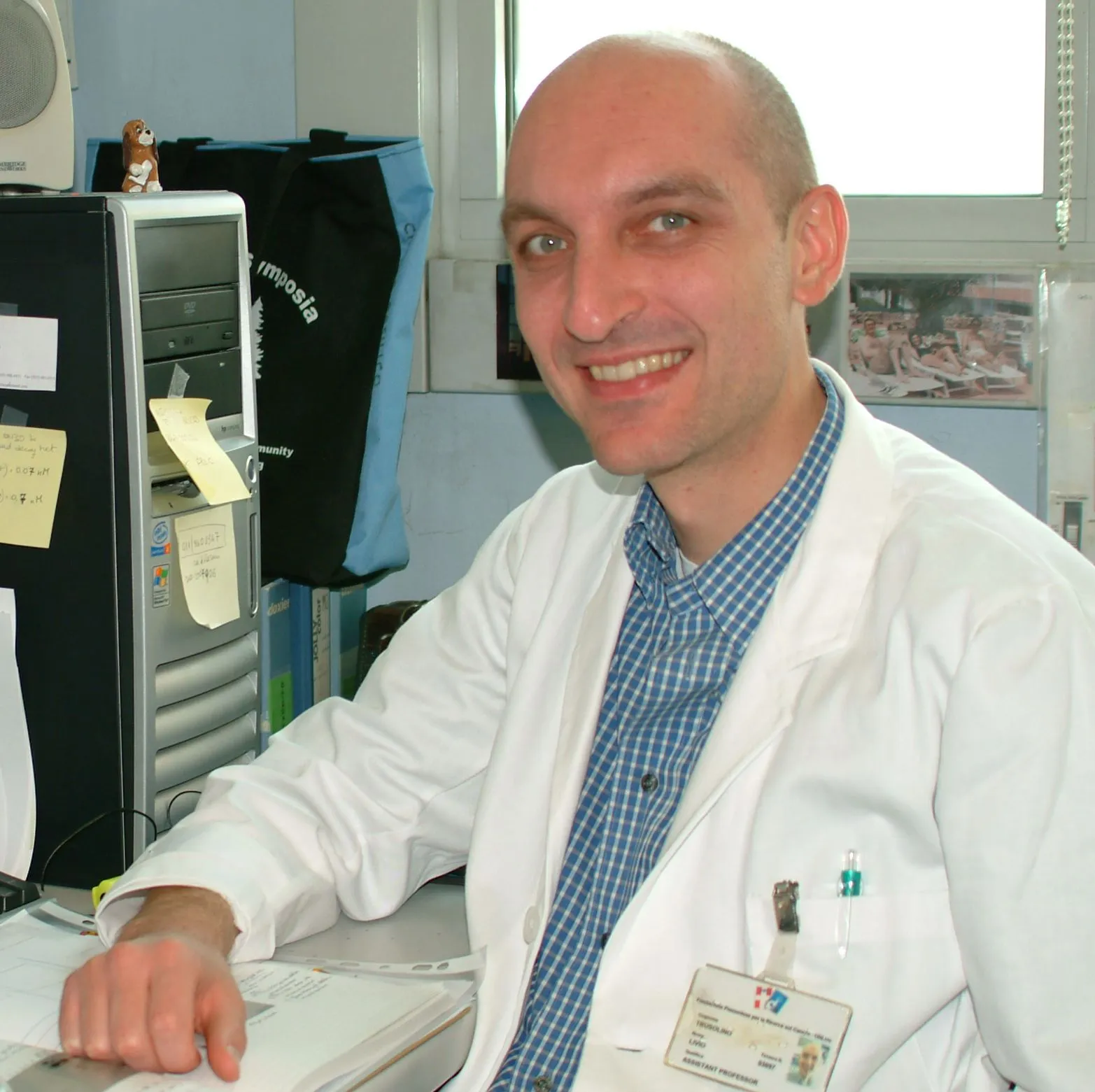
Livio Trusolino
University of Torino, Candiolo Cancer Institute - IRCSS
Biography
Livio Trusolino is Full Professor at the University of Turin Medical School in Turin, Italy. He also serves as the Director of the Laboratory of Translational Cancer Medicine at the Candiolo Cancer Institute in Turin, where he leads a dynamic team of young scientists.
Livio earned his M.D. from the University of Turin and a Ph.D. in Human Oncology from the San Raffaele Scientific Institute in Milan, Italy. His early research delved into unravelling the interplay between growth factor receptors and adhesion molecules in the initiation and progression of tumours. In more recent years, his work has charted new frontiers in translational and clinical oncology. By persistently exploring oncogenic signals, with a particular emphasis on colorectal cancer, his research group has unearthed diagnostically applicable drug resistance biomarkers and novel therapeutic targets, several of which have advanced into clinical application.
Livio’s studies have been published in leading journals, including Nature, Cell, Nature Genetics, Lancet Oncology, Cancer Discovery, Cancer Cell, and Science Translational Medicine. Additionally, he has contributed review articles to Nature Reviews Clinical Oncology, Nature Reviews Cancer, Nature Reviews Molecular and Cellular Biology, and Nature Reviews Drug Discovery.
Committed to rapidly disseminating his scientific findings, Livio dedicates a substantial portion of his time to educational endeavours. He often co-organises, and is regularly invited to, conferences on molecular and translational oncology. He maintains an active role in peer reviewing for grant agencies and top-tier scientific journals, viewing this service as integral to the scientific community. Livio also holds positions on the Editorial Boards of Cancer Discovery and Science Translational Medicine.
Beyond his scientific pursuits, Livio is a passionate cinephile. He also finds solace in exploring remote regions of Africa and South America during his spare moments.
Relevant Publications
- The molecular and functional landscape of resistance to FOLFIRI chemotherapy in metastatic colorectal cancerAvolio M., et al., Bertotti A.*, Trusolino L.*, (* senior and corresponding authors), Cancer Discovery (2026).
- Heterogeneity and evolution of DNA mutation rates in microsatellite stable colorectal cancerGrassi E., et al., Trusolino L.*, Bertotti A.*, (* senior and corresponding authors), Science Translational Medicine (2025).
- XENTURION is a population-level multidimensional resource of xenografts and tumoroids from metastatic colorectal cancer patientsLeto S.M., et al., Bertotti A.*, Trusolino L.*, (* senior and corresponding authors), Nature Communications (2024).
- Towards precision oncology with patient-derived xenograftsZanella E.R., Grassi E., Trusolino L.*, (* senior and corresponding authors), Nature Reviews Clinical Oncology (2022).
- Conservation of copy number profiles during engraftment and passaging of patient-derived cancer xenograftsWoo X.Y., et al., Isella C., Moscow J.A., Trusolino L., Byrne A.T., Jonkers J., Bult C.J., Medico E., Chuang J.H., PDXNET Consortium, EurOPDX Consortium, (senior authors), Nature Genetics (2021).
- Colorectal cancer residual disease at maximal response to EGFR blockade displays a druggable Paneth cell-like phenotypeLupo B., et al., Bertotti A.*, Trusolino L.*, (* senior and corresponding authors), Science Translational Medicine (2020).
- Selective analysis of cancer-cell intrinsic transcriptional traits defines novel clinically relevant subtypes of colorectal cancerIsella C., et al., Trusolino L.#, Medico E.#, Bertotti A.#, (# corresponding authors), Nature Communications (2017).
- Dual-targeted therapy with trastuzumab and lapatinib in treatment-refractory, KRAS codon 12/13 wild-type, HER2-positive metastatic colorectal cancer (HERACLES): a proof-of-concept, multicentre, open-label, phase 2 trialSartore-Bianchi A., Trusolino L., et al., Bardelli A., Marsoni S., Siena S., (senior authors), Lancet Oncology (2016).
- The genomic landscape of response to EGFR blockade in colorectal cancerBertotti A., et al., Trusolino L.*, Velculescu V.E.*, (* senior and corresponding authors), Nature (2015).
- IGF2 is an actionable target that identifies a distinct subpopulation of colorectal cancer patients with marginal response to anti-EGFR therapiesZanella E.R., et al., Trusolino L.*, Bertotti A.*, (* senior and corresponding authors), Science Translational Medicine (2015).