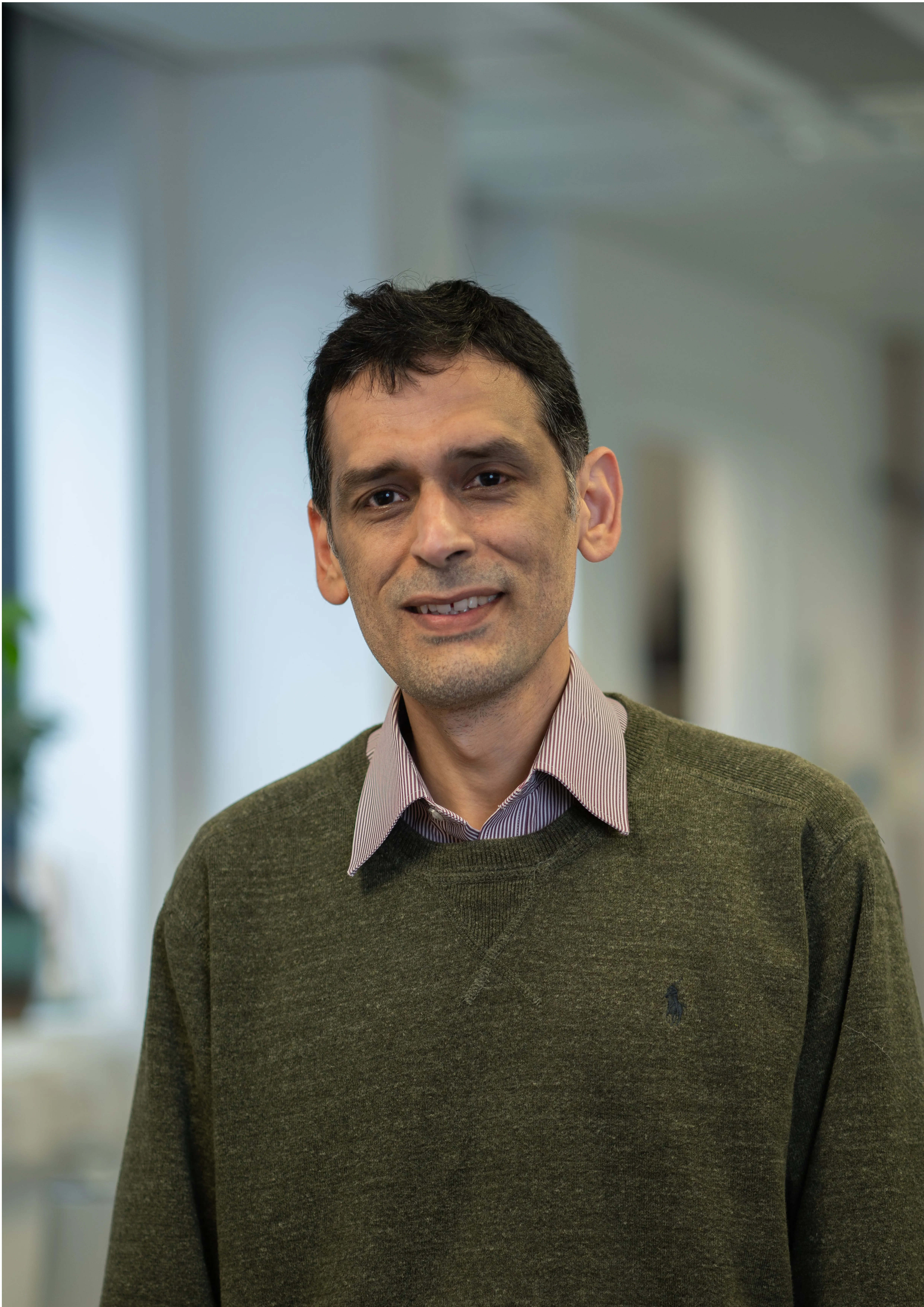
Syed Haider
London Institute of Cancer Research
Biography
Syed Haider is a Group Leader of the Breast Cancer Data Science team at The Institute of Cancer Research, London. He received a PhD in Computer Science and Technology, focusing on graph-theoretic networks for cancer prognosis, from the University of Cambridge. Following his PhD, he pursued postdoctoral training at the University of Oxford, where he studied the role of the hypoxic tumour microenvironment in the selection of metabolic alterations in human cancers. Alongside his PhD and postdoctoral research, he also served as the lead software developer for the BioMart genomic data-management system.
Dr. Haider’s research primarily focuses on developing in-silico methods to identify novel therapeutic targets in cancer using synthetic lethal approaches. He is also interested in the identification of prognostic and predictive biomarkers for hard-to-treat breast cancers using statistical machine learning and artificial intelligence.
Relevant Publications
- Proteogenomic discovery of RB1-defective phenocopy in cancer predicts disease outcome, response to treatment, and therapeutic targetsIacovacci J., Brough R., Moughari F. A., Alexander J., Kemp H., Tutt A. N. J., Natrajan R., Lord C. J., Haider S., Science Advances (2025).
- The transcriptomic architecture of common cancers reflects synthetic lethal interactionsHaider S., Brough R., Madera S., Iacovacci J., Gulati A., Wicks A., Alexander J., Pettitt S. J., Tutt A. N. J., Lord C. J., Nature Genetics (2025).
- Pathway-based signatures predict patient outcome, chemotherapy benefit and synthetic lethal dependencies in invasive lobular breast cancerAlexander J., Schipper K., Nash S., Brough R., Kemp H., Iacovacci J., Isacke C., Natrajan R., Sawyer E., Lord C. J., Haider S., British Journal of Cancer (2024).
- Identifying high-confidence capture Hi-C interactions using CHiCANEHolgersen E. M., Gillespie A., Leavy O. C., Baxter J. S., Zvereva A., Muirhead G., Johnson N., Sipos O., Dryden N. H., Broome L. R., Chen Y., Kozin I., Dudbridge F., Fletcher O., Haider S., Nature Protocols (2021).
- Systematic Assessment of Tumor Purity and Its Clinical ImplicationsHaider S., Tyekucheva S., Prandi D., Fox N. S., Ahn J., Xu A. W., Pantazi A., Park P. J., Laird P. W., Sander C., Wang W., Demichelis F., Loda M., Boutros P. C., Cancer Genome Atlas Research Network, JCO Precision Oncology (2020).
- Pathway-based subnetworks enable cross-disease biomarker discoveryHaider S., Yao C. Q., Sabine V. S., Grzadkowski M., Stimper V., Starmans M. H. W., Wang J., Nguyen F., Moon N. C., Lin X., Drake C., Crozier C. A., Brookes C. L., van de Velde C. J. H., Hasenburg A., Kieback D. G., Markopoulos C. J., Dirix L. Y., Seynaeve C., Rea D. W., Kasprzyk A., Lambin P., Lio P., Bartlett J. M. S., Boutros P. C., Nature Communications (2018).
- Genomic alterations underlie a pan-cancer metabolic shift associated with tumour hypoxiaHaider S., McIntyre A., van Stiphout R. G. P. M., Winchester L. M., Wigfield S., Harris A. L., Buffa F. M., Genome Biology (2016).
- A multi-gene signature predicts outcome in patients with pancreatic ductal adenocarcinomaHaider S., Wang J., Nagano A., Desai A., Arumugam P., Dumartin L., Fitzgibbon J., Hagemann T., Marshall J. F., Kocher H. M., Crnogorac-Jurcevic T., Scarpa A., Lemoine N. R., Chelala C., Genome Medicine (2014).
- BioMart Central Portal--unified access to biological dataHaider S., Ballester B., Smedley D., Zhang J., Rice P., Kasprzyk A., Nucleic Acids Research (2009).